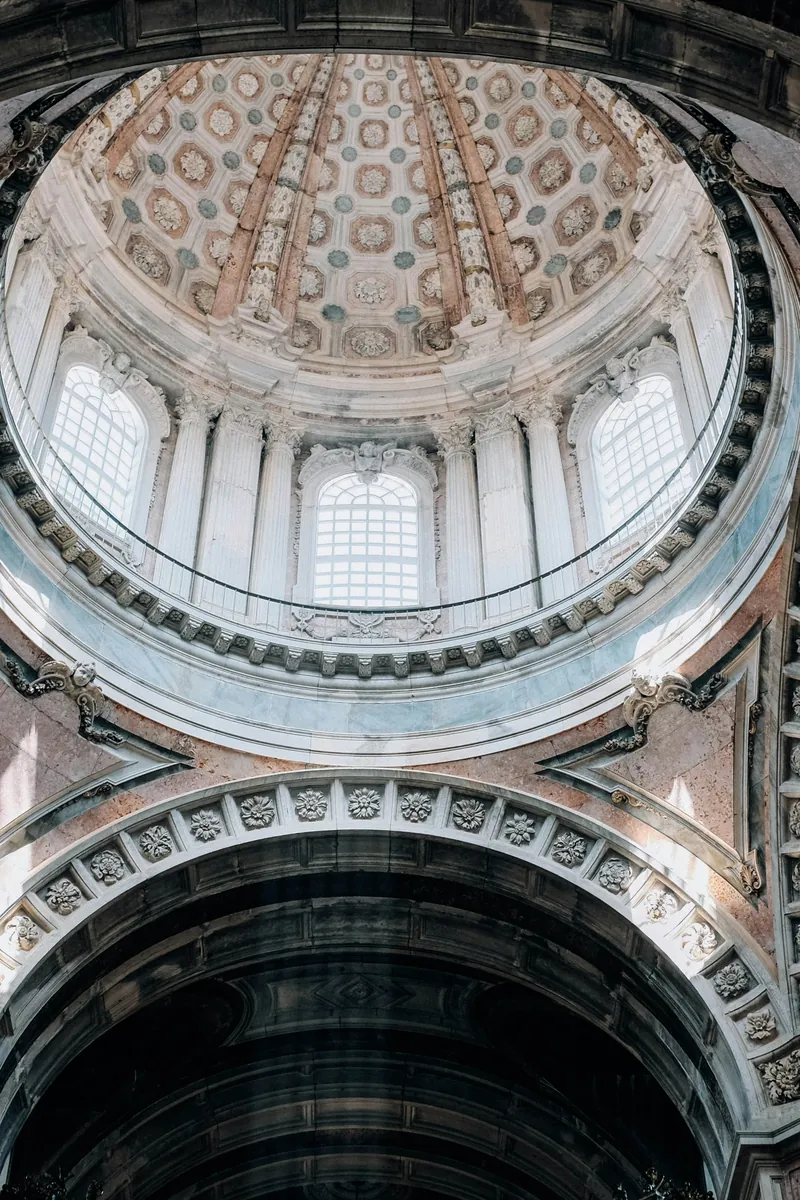
King João V's vow, paid in Brazilian gold
Palácio Nacional de Mafra is the monument King João V built to thank God for an heir — 220 metres of pink Italian marble façade, 1,200 rooms, a basilica with six organs that play together, and a baroque library where the bats still come out at dusk to eat the insects that would otherwise eat the 36,000 books. UNESCO since 2019, an hour from Lisbon.
Get your Mafra Palace ticket- UNESCO 2019 World Heritage Site — Royal Building of Mafra
- 1717-1755 Construction under King João V — 52,000 workers at peak
- 6 organs Basilica's six historic pipe organs — unique in the world
- 36,000 books Baroque library with resident bat colony
Tickets and tours for Palácio Nacional de Mafra
Compare the best-rated ways to visit, check live availability and book in a few taps.
- Top pick
Mafra: National Palace of Mafra Entry Ticket
Self-guided entry to the National Palace of Mafra: the royal apartments, the convent rooms and the Baroque library.
From US$17Check availability ↗ Mafra: National Palace and Convent Guided Tour
A guided tour of the palace and convent, including the Baroque library and the story of King João V's vow.
From US$88Check availability ↗From Lisbon: Mafra, Ericeira & Queluz Palace Day Tour
A guided day with hotel pickup that combines Mafra with the coastal town of Ericeira and Queluz; palace entry fees are paid on top.
From US$89Check availability ↗
More things to do nearby
About Palácio Nacional de Mafra
The Palácio Nacional de Mafra was begun in 1717 by King João V of Portugal in fulfillment of a vow made to obtain an heir from his Habsburg queen, Maria Anna of Austria. Their daughter Maria Bárbara, the future Queen of Spain, had been born in 1711, and the king kept his promise on an extraordinary scale. The architect was Johann Friedrich Ludwig (João Frederico Ludovice), a German-trained jeweller and architect who had worked in Rome under Carlo Fontana and brought a late Roman baroque idiom to the Estremadura limestone hills.
Construction lasted into the 1750s, with 52,000 workers reportedly on site at peak and 1,383 documented worker deaths. The complex was funded almost entirely by the Brazilian gold cycle — the alluvial diamonds and gold of Minas Gerais that briefly made Portugal the richest crown in Europe. The basilica was consecrated in 1730 in time for the king's birthday. The 220-metre main façade encloses a 38,000 m² floor plan with 1,200 rooms, 4,700 doors and windows, two bell towers carrying a 92-bell carillon, and a single basilica dome.
Three features are unique. The first is the basilica's six historic pipe organs — built between 1792 and 1807 by António Xavier Machado e Cerveira and Joaquim António Peres Fontanes to a specification that allows all six to be played together as a single 30,000-pipe instrument. The second is the baroque library, 88 metres long, holding 36,000 leather-bound volumes from the 14th to the 19th century, where a resident colony of small bats (Pipistrellus and Plecotus species) is left undisturbed because they eat the insects that would otherwise eat the books. The third is the Tapada de Mafra — a 1,200-hectare walled hunting park behind the palace, the largest enclosed royal hunting reserve in Europe, still home to red deer, wild boar and Iberian fallow deer.
The 'Royal Building of Mafra — Palace, Basilica, Convent, Cerco Garden and Hunting Park' was inscribed on the UNESCO World Heritage list in 2019. The complex appears in José Saramago's 1982 novel Baltasar and Blimunda, which dramatizes the lives of the workers who built it and won Saramago the literary recognition that led to his 1998 Nobel Prize.
Practical information
- Address
- Terreiro D. João V, 2640-492 Mafra, Portugal
- Hours
- Wednesday to Monday 09:30–17:30 (last entry 16:30). Closed Tuesdays. Annual closures: January 1, Easter Sunday, May 1, Ascension Thursday, December 25.
- Getting there
- By car: 45-60 minutes from central Lisbon via the A8 motorway (exit Mafra). Free street parking around the Terreiro D. João V. By bus: Mafrense direct service from Lisbon Campo Grande to Mafra terminal (~75 min), then 5-minute walk. No direct train.
- Time needed
- 2.5 to 3 hours for the standard palace + basilica + library route. Add 30 minutes for the rooftop terraces (separate ticket). Add a half-day if you also visit the Tapada hunting park (separate ticket, separate entrance 3 km outside town).
- What to wear
- Comfortable shoes — the palace floor plan is enormous and you walk continuously for 2 hours+. Smart-casual is appreciated in the basilica (it remains a consecrated Catholic church). Layers in winter — the convent and library are unheated.
- Accessibility
- Most of the palace ground floor and basilica are wheelchair accessible. Upper floors have some step access only. The library has a step at the threshold. The rooftop terraces are reached by stairs.
Plan your visit
Practical guides written by our travel team
How to Get to Mafra Palace from Lisbon
Getting to Mafra Palace from Lisbon: Mafrense direct bus from Campo Grande, A8 motorway by car, taxi options, parking, and the perfect day-trip schedule.
The Mafra Library and the Six Basilica Organs
An 88-metre rococo library protected by a colony of bats, and six pipe organs designed to play together as a single instrument — the two extraordinary features that set Mafra apart from every other baroque monument in Europe.
Mafra Palace and the Tapada de Mafra: A Combined Visit
How to plan a full day combining the baroque palace with the eighteenth-century walled royal hunting park immediately behind it — including jeep tours, the autumn rut, and the practical logistics of two separate tickets.
Frequently asked
What are the opening hours?
Wednesday to Monday 09:30 to 17:30, with last entry at 16:30. Closed Tuesdays and on January 1, Easter Sunday, May 1, Ascension Thursday, and December 25.
Where exactly is the palace?
Terreiro D. João V, 2640-492 Mafra, in the town of Mafra in Lisbon district. About 30 km north-west of central Lisbon — 45-60 minutes by car or 75 minutes by Mafrense direct bus from Campo Grande.
Why does the palace exist?
King João V vowed in 1711 that if he was given an heir he would build a Franciscan convent at Mafra. His daughter Maria Bárbara was born that year. He kept the promise on a vast scale — the building absorbed much of the Brazilian gold cycle. Construction began in 1717; the basilica was consecrated in 1730.
Why is it UNESCO World Heritage?
Inscribed in 2019 as the 'Royal Building of Mafra — Palace, Basilica, Convent, Cerco Garden and Hunting Park'. Cited as one of the most representative monuments of Portuguese late baroque, with the unified design of palace, religious complex and royal hunting park.
Are there really bats in the library?
Yes. A small resident colony of insectivorous bats (Pipistrellus and Plecotus species) lives behind the bookcases of the 88-metre baroque library, where they hunt the moths, silverfish and woodborers that would otherwise damage the 36,000 leather-bound volumes. Library staff have left them undisturbed since the 18th century. They emerge at dusk; during daytime visits you may see droppings on the floor under the bookcases.
How long does a visit take?
2.5 to 3 hours for the standard route through palace, basilica and library. Add 30 minutes for the rooftop terraces (separate add-on ticket). Add a half-day if you also want to visit the Tapada de Mafra hunting park (separate entrance 3 km outside town, separate ticket).
What is the Tapada de Mafra?
The 1,200-hectare walled royal hunting park immediately behind the palace. The largest enclosed royal hunting reserve in Europe, still home to red deer, wild boar and Iberian fallow deer. Open to visitors with separate tickets (not included in the palace ticket); the entrance is 3 km north of the palace at Portão do Codeçal.
Is there a dress code?
The basilica remains a consecrated Catholic church — shoulders covered is appreciated. Smart-casual is fine throughout the palace. No swimwear or beachwear.
Can I take photographs?
Yes, throughout the palace and basilica without flash. No tripods without a permit. The library is photographable but no flash (the books are light-sensitive).
Is it suitable for children?
Yes — children love the scale, the bell tower views and the basilica. The library is a quiet space and small children should be kept calm there. Allow 2 hours with under-10s and skip the slower royal-apartment rooms.
How do I get there from Lisbon by public transport?
Mafrense (Barraqueiro Group) runs direct buses from Lisbon Campo Grande (Metro yellow/green) to Mafra terminal, roughly hourly during the day, 75 minutes. The palace is a 5-minute walk from the bus terminal. There is no direct train; trains require a change at Lisbon Sintra/Mira Sintra and are slower.
Is there parking?
Yes — free street parking around the Terreiro D. João V immediately in front of the palace. Fills on weekends from 11:00 onward.
Is there food on site?
There is a small café in the visitor centre. For lunch, the town centre 200 m south has several restaurants — try the local Mafra sausage (linguiça de Mafra) and a vinho de Bucelas from the nearby DOC.
Did Saramago write a novel about this place?
Yes — José Saramago's 1982 novel Baltasar and Blimunda (Memorial do Convento in Portuguese) dramatizes the lives of the workers who built Mafra. Saramago won the 1998 Nobel Prize in Literature and the novel is the principal literary work associated with the palace.
What language are the displays in?
Portuguese and English on all main interpretive panels. Audio guide available in EN, FR, ES, DE, IT, NL at the entrance.
What is the Palace of Mafra?
The Palace of Mafra (Palácio Nacional de Mafra) is a monumental eighteenth-century Baroque palace-convent-basilica in the town of Mafra, central Portugal, roughly thirty kilometres north-west of Lisbon. Construction began in 1717 under King João V and continued until 1755, funded largely by gold from Brazil during the height of Portuguese imperial wealth. It is one of the largest Baroque buildings in Portugal, covering around 37,800 square metres with some 1,200 rooms. The complex unites a royal residence, a Franciscan monastery, and a basilica decorated with Italian marble statues. It is celebrated for several rare features: a Rococo library holding tens of thousands of leather-bound volumes, six historic pipe organs, and two carillons containing dozens of bells cast in Antwerp. Behind the palace lies the Tapada, a vast walled royal hunting park. The Royal Building of Mafra was inscribed as a UNESCO World Heritage Site in 2019.
How do I get to the Palace of Mafra?
The Palace of Mafra stands in the town of Mafra, approximately thirty kilometres north-west of central Lisbon, and is reached most easily by road. Travelling by car, drivers follow the A8 motorway north from Lisbon, branching onto the A21 towards Mafra, a journey of roughly forty-five minutes to an hour depending on traffic. The A8 is a tolled motorway. Parking is available around the Terreiro D. João V, the broad square directly in front of the palace, though spaces fill quickly at weekends and on public holidays. For those without a car, Mafrense regional buses run from Lisbon's Campo Grande terminal, which sits on the city's metro network, directly to Mafra in around seventy-five minutes. The bus terminal lies a short walk from the palace entrance. There is no railway station in Mafra, so train travel is not a practical option for reaching the site.
How does booking work on this site?
This site is an independent visitor guide to Palácio Nacional de Mafra. When you choose a ticket or tour, you book it directly with GetYourGuide, which takes the payment, issues the ticket and handles any changes or cancellations. We may earn a commission when you book, at no extra cost to you.